

Hybrid servicing requires workshops to combine established vehicle maintenance practices with procedures designed specifically for electrified drivetrains. Hybrid vehicles use a combination of an internal combustion engine and electric propulsion components, which means technicians may need to work across conventional mechanical systems, high-voltage electrical components, battery systems and sophisticated electronic controls.
For UK garages, this creates an operational challenge as well as a technical one. A workshop needs suitable equipment, trained technicians, clear safety procedures and an efficient workflow. The aim is not simply to service hybrid vehicles correctly, but to integrate hybrid work into everyday workshop operations without creating unnecessary delays or compromising safety.
What Is Hybrid Servicing?
Hybrid servicing covers the inspection, maintenance, diagnosis and repair of vehicles that use both an internal combustion engine and an electric propulsion system. The exact service requirements vary according to the vehicle manufacturer, model, age and hybrid system design.
Some maintenance tasks remain familiar. Brakes, tyres, suspension, steering, fluids, filters and other conventional components still require inspection and maintenance. However, hybrid vehicles also introduce additional systems that require specialist knowledge.
These can include high-voltage batteries, electric motors, power electronics, regenerative braking systems, cooling circuits and sophisticated control modules.
Consequently, workshops need to understand which procedures can be performed using conventional methods and which require specialist training, equipment or isolation procedures.
Why Hybrid Servicing Requires Different Workshop Procedures
The presence of high-voltage components changes how technicians approach certain jobs. A vehicle that appears mechanically similar to a conventional car can contain electrical systems that require specific precautions before work begins.
Workshop procedures therefore need to cover vehicle identification, system status, safe isolation where required, appropriate personal protective equipment and verification that work can proceed safely.
This is particularly important when a repair involves components connected to the high-voltage system. Technicians should follow the vehicle manufacturer’s procedures and use equipment appropriate for the vehicle being serviced.
For workshop managers, this means hybrid capability should be treated as a complete operational process rather than simply purchasing a diagnostic tool and assigning hybrid jobs to a technician.
Hybrid Servicing Starts with the Correct Vehicle Assessment
A strong hybrid servicing workflow begins before the vehicle reaches the workshop bay. During booking or vehicle reception, staff should identify the vehicle type and establish the customer’s reason for the visit.
This information can help determine whether the job is routine maintenance, a warning-light investigation, a mechanical repair or a potential high-voltage system issue.
Accurate job information also helps workshop managers allocate the appropriate technician and equipment. A routine tyre replacement may require no specialist hybrid procedure, while an electrical fault investigation may require a technician with specific hybrid training.
Vehicle Reception
At reception, the customer’s reported symptoms should be recorded clearly. Warning messages, unusual noises, reduced performance and changes in vehicle behaviour can all provide useful diagnostic information.
A digital vehicle inspection can also document the condition of the vehicle before work begins. This supports transparency and provides technicians with a structured starting point.
Initial Inspection
The technician should then assess the vehicle according to the manufacturer’s recommended service process. Conventional components can be inspected alongside hybrid-specific systems where appropriate.
The inspection should identify whether additional diagnostic work is necessary before the vehicle moves further through the workshop process.
Toyota Hybrid Service and Manufacturer-Specific Procedures
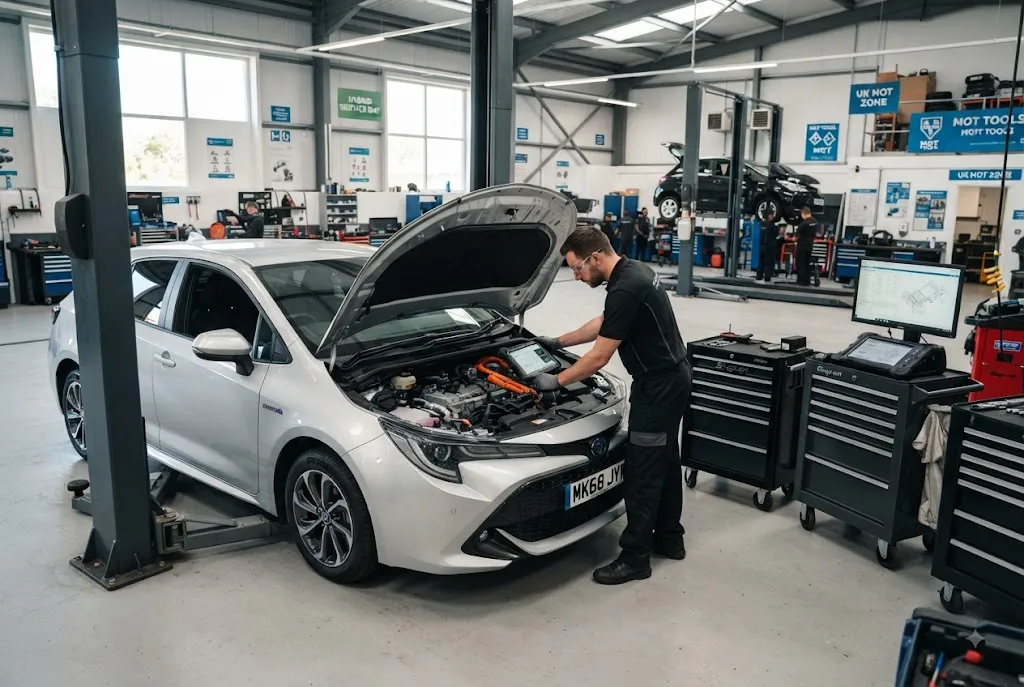
Toyota hybrid service requirements provide a useful example of why workshops should avoid treating every hybrid vehicle as operationally identical. Also Toyota has developed hybrid systems across a broad range of vehicles, but service procedures still need to be based on the specific vehicle and manufacturer guidance.
A technician working on a Toyota hybrid needs to understand the relevant hybrid architecture, diagnostic information and safety procedures for that vehicle. The same principle applies to hybrid systems from other manufacturers.
Independent garages should therefore avoid relying on generic assumptions about hybrid technology. Vehicle-specific technical information and appropriate training are important parts of a professional workshop process.
Hybrid Diagnostics in the Workshop
Hybrid diagnostics can involve more than reading a fault code. A warning message may relate to the battery, inverter, motor-generator, engine, cooling system, sensors or communication between electronic control units.
Diagnostic equipment should therefore be capable of accessing the systems relevant to the vehicle. Technicians also need the knowledge to interpret diagnostic information rather than replacing components based on a fault code alone.
A structured diagnostic workflow can help:
- Confirm the customer’s reported symptoms.
- Check relevant warning messages and vehicle information.
- Perform an appropriate diagnostic scan.
- Review fault codes and supporting data.
- Follow the manufacturer’s diagnostic procedure.
- Test suspected components before replacement.
- Verify the repair after completion.
This approach reduces unnecessary parts replacement and helps workshops maintain consistent diagnostic quality.
Hybrid Battery Management
Battery management is an important part of hybrid workshop capability. Hybrid batteries operate as part of an integrated vehicle system rather than as a simple standalone component.
Depending on the vehicle and the issue being investigated, technicians may need to consider battery condition, temperature management, charging and discharging behaviour, system warnings and associated electrical components.
Work involving high-voltage battery systems should only be undertaken by appropriately trained personnel following the correct safety procedures. Workshops should also understand their own competence limits and refer specialist work elsewhere when necessary.
Battery Cooling
Temperature management is important because battery performance can be affected by operating conditions. Hybrid systems may use dedicated cooling arrangements to control battery temperature.
During relevant inspections, technicians should follow manufacturer procedures for checking the applicable cooling system and associated components.
Battery-Related Faults
A warning involving a hybrid battery does not necessarily mean the complete battery pack requires replacement. Diagnostic testing should establish the cause of the problem before a major component is recommended.
This is another reason why hybrid workshop capability depends heavily on technician training and accurate diagnostic processes.
Regenerative Braking and Conventional Maintenance
Hybrid vehicles can use regenerative braking to recover energy during deceleration. This can change the way braking components are used compared with some conventional vehicles.
However, friction brakes remain important and still require appropriate inspection. Brake discs, pads, calipers, brake fluid and related components should be assessed according to the manufacturer’s requirements and the vehicle’s condition.
Technicians should not assume that reduced conventional brake use means braking maintenance can be ignored. Instead, the inspection process should reflect the vehicle’s actual operating system.
Workshop Safety for Hybrid Vehicles
Safety is one of the most important elements of hybrid workshop procedures. High-voltage systems can present serious risks if handled incorrectly.
Workshops should establish clear procedures covering vehicle identification, safe working areas, technician competence, isolation processes where required, suitable equipment and emergency arrangements.
Training should also extend beyond technicians where appropriate. Service advisors and workshop staff need to recognise hybrid vehicles and understand when specialist procedures may be required.
A clear escalation process can prevent unsuitable work from being assigned to technicians who do not have the required competence or equipment.
Hybrid Services Beyond Routine Maintenance
Modern hybrid workshops may offer a range of hybrid services, from routine servicing and inspections to diagnostics and selected electrical system repairs.
The service portfolio should match the workshop’s actual capability. Offering specialist work without suitable equipment or trained personnel can create unnecessary operational and safety risks.
Instead, garages can develop capability gradually. Routine hybrid maintenance can form the foundation, followed by advanced diagnostics and more specialist services as training and equipment develop.
Integrating Hybrid Jobs into Workshop Scheduling
Hybrid vehicles should be incorporated into the wider workshop schedule rather than treated as an entirely separate business process.
However, some hybrid jobs may require more preparation than conventional maintenance. A diagnostic investigation, for example, can be less predictable than a routine oil and filter service.
Workshop managers should therefore consider job complexity when allocating technician time. Booking systems can capture vehicle type and service requirements so that appropriate resources are available when the vehicle arrives.
This connects directly with broader automotive operations, where technician scheduling, workshop capacity, workflow management and performance measurement all influence overall service efficiency.
Technician Training and Skills
Hybrid capability depends on people as much as equipment. Technicians need appropriate training for the systems and procedures they are expected to work on.
Training should cover the relevant technical systems, diagnostic methods and safety procedures. Managers should also maintain clear records of technician competencies so that jobs can be assigned appropriately.
This helps prevent a common operational problem: having hybrid vehicles in the booking system without having a suitably trained technician available when the work is scheduled.
Managing Hybrid Workshop Equipment
Specialist equipment should form part of the workshop’s operational planning. Depending on the services offered, this may include suitable diagnostic equipment, electrical test equipment, protective equipment and tools designed for hybrid applications.
Equipment availability can affect scheduling. If a specialist tool is shared between technicians or branches, managers need to know when it is available before confirming certain jobs.
Regular equipment inspection and maintenance should also be included in workshop procedures.
Quality Control After Hybrid Work
Final checks are particularly important after hybrid-related work. The vehicle should be assessed according to the relevant manufacturer procedure and the work carried out.
Where diagnostic faults have been addressed, the technician should confirm that the repair has resolved the original issue and that the vehicle behaves as expected. Any required warning-system checks or post-repair procedures should also be completed.
Clear documentation provides an additional layer of quality control. The job record should show what was inspected, what work was completed and any recommendations that remain outstanding.
How Hybrid Servicing Can Improve Workshop Capability
Developing hybrid servicing capability can help a garage adapt to the changing vehicle parc. However, the strongest approach is based on controlled operational development rather than simply advertising hybrid services.
A workshop can assess its current position across several areas:
- Technician training and competence.
- Hybrid diagnostic capability.
- High-voltage safety procedures.
- Specialist tools and equipment.
- Workshop scheduling.
- Parts and component availability.
- Quality control procedures.
- Customer communication.
Identifying gaps in these areas makes it easier to build a realistic development plan.
Hybrid Workshops and Future EV Capability
Hybrid capability can also provide useful operational experience for workshops preparing for greater electric vehicle demand. Although hybrids and fully electric vehicles are not identical, both require technicians and managers to understand more advanced electrical systems and diagnostic workflows.
Garages planning broader electrification capability should therefore consider how their existing processes can evolve. Developing EV servicing capability may eventually require additional training, equipment, workshop procedures and technician scheduling.
The transition should be managed carefully. Hybrid and EV work should not disrupt the workshop’s ability to maintain conventional vehicles, which will remain an important part of the UK vehicle market for years.
Measuring Hybrid Workshop Performance
Once hybrid services are established, workshops can measure their performance using operational indicators. Useful measures can include the number of hybrid jobs completed, average diagnostic time, first-time fix rate, repeat work, technician utilisation and customer satisfaction.
These metrics can be compared over time to determine whether processes are improving.
It can also be useful to separate routine hybrid maintenance from complex diagnostics. Otherwise, a small number of difficult jobs could distort the overall performance figures.
Common Hybrid Workshop Process Problems
Several operational issues can reduce the effectiveness of a hybrid service offering.
Insufficient Technician Availability
If only one technician is trained for hybrid work, that person can quickly become a bottleneck. Training multiple suitable team members can improve resilience and scheduling flexibility.
Incorrect Job Allocation
A hybrid vehicle may be booked without identifying the type of work required. If the workshop discovers specialist requirements only after the vehicle arrives, delays can follow.
Inadequate Diagnostic Information
Complex hybrid faults can take longer to resolve when technicians lack the correct technical information or diagnostic access. Reliable information sources should therefore be part of the workshop’s operating model.
Weak Safety Procedures
Safety processes should never be improvised. Workshops need clear procedures and appropriately trained personnel for work involving high-voltage systems.
Creating a Consistent Hybrid Workshop Workflow
A practical hybrid workflow can connect customer booking, vehicle identification, technician allocation, inspection, diagnosis, repair, quality control and handover.
At booking, the workshop identifies the vehicle and service requirement. At reception, the customer’s concern and vehicle condition are recorded. The appropriate technician is then assigned, with specialist resources reserved when required.
After inspection and diagnosis, the required work is completed according to the applicable procedure. Finally, quality checks and customer communication complete the process.
Consistency is important because it makes performance easier to measure and helps prevent avoidable omissions.
Final Thoughts on Hybrid Servicing
Hybrid servicing requires a combination of technical knowledge, safety procedures, diagnostic capability and effective workshop management. Garages need to understand the differences between conventional maintenance and hybrid-specific work while ensuring that every job follows an appropriate process.
As hybrid vehicles remain an important part of the UK’s changing vehicle landscape, workshops that invest in training, equipment and structured procedures can build stronger long-term capability. The most effective approach is not simply to add hybrid services to a menu, but to integrate them into a reliable operational system that protects technicians, supports quality repairs and delivers a consistent customer experience.