

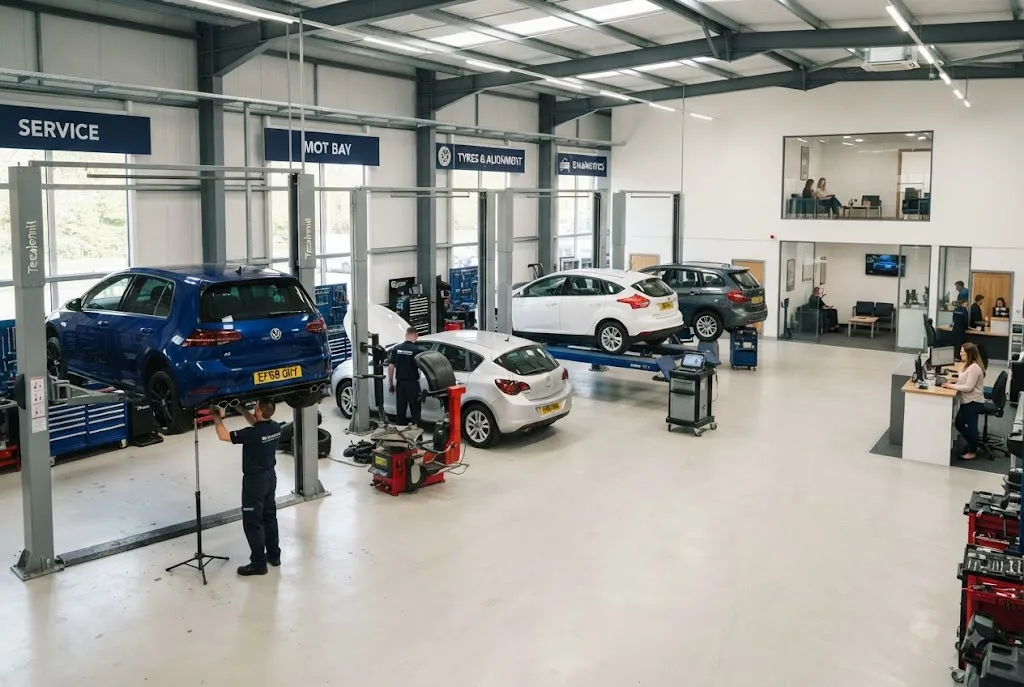
Garage chains play a major role in the UK’s automotive service market, giving motorists access to established networks for tyres, MOT testing, servicing, repairs and other maintenance needs. However, comparing garage chains is not simply a matter of looking at branch numbers or advertised prices. A meaningful benchmark needs to consider service performance, operational consistency, workshop capability, customer experience and how effectively each network manages its sites.
Large automotive networks such as National Tyres & Autocare, Kwik Fit, ATS Euromaster, Halfords, Protyre, Fix Auto and Fast Fit Autocentres operate with different business models and service mixes. That makes direct comparisons more useful when they focus on measurable operational factors rather than broad claims about which company is “best”.
Why Benchmark Garage Chains?
Benchmarking provides a structured way to understand how automotive service networks perform across multiple locations. For customers, it can help explain differences in service availability, booking experiences and workshop standards. For operators, it provides a framework for identifying underperforming sites and replicating processes that work well elsewhere.
The challenge is that a national network can contain branches with very different local conditions. Workshop size, technician availability, vehicle mix, local demand and management capability can all influence results. Consequently, a useful comparison should examine performance at branch level as well as across the wider network.
For example, a garage may achieve high customer throughput because it has strong local demand, while another may have lower volumes but excellent productivity and customer retention. Looking at one number in isolation can therefore create a misleading picture.
What Should Garage Chains Be Measured Against?
A strong benchmarking model should combine operational, customer and commercial measures. The objective is not to create a league table based on one metric, but to establish a balanced view of how consistently a network delivers its services.
Workshop Productivity
Productivity is one of the most important measures for any multi-site automotive business. Useful indicators include jobs completed per technician, labour hours sold, workshop utilisation, average job duration and productive hours compared with available technician hours.
These measures can highlight differences between branches and help managers identify where capacity is being lost. Low productivity does not automatically mean poor staff performance. It may point towards inefficient booking schedules, parts delays, inadequate equipment, vehicle handover problems or inconsistent workflow management.
Service Quality
Service quality should sit alongside productivity rather than being treated as a separate concern. A workshop that completes more jobs but generates a high level of rework may be less effective than a slightly slower site that consistently completes repairs correctly the first time.
Useful quality indicators can include repeat repairs, comeback rates, customer complaints, warranty claims, MOT performance and inspection outcomes. The DVSA guidance for managing an MOT centre highlights the importance of management systems, quality control, tester standards, premises and equipment when maintaining MOT testing standards.
Customer Experience
Customer experience is another important part of service performance. Booking convenience, communication, vehicle collection processes, quotation clarity and completion times can influence whether a customer returns.
For garage chains, consistency matters particularly because customers often expect the same basic standard regardless of which branch they visit. A strong central brand can be weakened if customer experiences vary significantly between locations.
Capacity and Availability
A branch can have technically strong staff but still underperform commercially if customers cannot secure convenient appointments. Measuring booking lead times, available workshop hours, cancelled bookings and technician capacity can reveal whether a network is using its physical resources effectively.
Comparing Major UK Garage Chains
Several established names provide useful examples of the different approaches found within the UK’s automotive service sector. The purpose of benchmarking them is not to declare a universal winner, but to understand the operational characteristics that can influence service performance.
National Tyres & Autocare
National Tyres & Autocare is particularly associated with fast-fit services, including tyres, exhausts, brakes, batteries, MOT testing, vehicle inspections and servicing. The company states that it is part of the Halfords family and operates more than 200 National Tyres & Autocare garages within the wider Halfords network.
For benchmarking purposes, a network with a strong fast-fit focus can be assessed through measures such as tyre fitting productivity, stock availability, booking conversion, workshop utilisation and the speed at which common jobs are completed.
Kwik Fit
Kwik Fit is one of the UK’s most recognisable automotive service brands, with a business model built around a broad network of local service centres. Its scale makes consistency particularly important when assessing service performance.
A useful benchmarking exercise would examine branch-level differences in appointment availability, job completion times, technician productivity, customer feedback and repeat work. Comparing these indicators can reveal whether operating processes are being applied consistently across the network.
ATS Euromaster
ATS Euromaster combines tyre services with broader automotive maintenance and fleet-related services. Its positioning makes it useful to consider both consumer and business-focused performance measures.
For example, fleet customers may place greater emphasis on vehicle availability, turnaround time, account management and predictable service processes. These requirements can create different operational priorities from those of a customer booking a single tyre replacement.
Halfords
Halfords operates a substantial automotive service network and also has a wider retail presence. Its automotive operations can therefore be assessed across several customer touchpoints, including booking, workshop service, product supply and post-service support.
The scale of its network also demonstrates why central processes, technician training, parts availability and quality controls are important when maintaining a consistent customer proposition across multiple locations.
Protyre
Protyre has developed a network covering tyre services, MOT testing, servicing and vehicle repairs. Benchmarking a network such as Protyre can involve examining both traditional fast-fit measures and broader workshop performance.
Useful measures include first-time fix rates, technician productivity, alignment and balancing efficiency, booking utilisation and customer retention.
Fix Auto
Fix Auto represents a different operational model because its network is strongly associated with vehicle body repair. This means its performance indicators need to reflect the complexity and duration of collision repair work rather than simply applying fast-fit benchmarks.
Cycle time, repair quality, parts coordination, estimation accuracy, customer communication and vehicle handover performance can be particularly important measures for a body repair network.
Fast Fit Autocentres
Fast Fit Autocentres illustrates the importance of comparing businesses according to their service model rather than assuming that every garage chain operates in exactly the same way. Fast-fit operations generally need efficient workflows for high-volume maintenance and repair tasks.
Benchmarking should therefore consider appointment scheduling, technician utilisation, job turnaround, parts availability and the ability to maintain quality during periods of high demand.
Service Performance Goes Beyond Customer Reviews
Online reviews can provide valuable insight into customer sentiment, but they should not be treated as the complete measure of garage performance. Reviews are subjective and may reflect individual experiences rather than underlying operational trends.
A more robust approach combines customer feedback with measurable workshop data. For example, a network could compare customer satisfaction with first-time fix rates, repeat visits, complaints, job duration and appointment availability.
This creates a more balanced picture. If customer satisfaction falls while workshop utilisation rises sharply, management may need to investigate whether increased workload is affecting service quality. Conversely, low utilisation combined with strong customer satisfaction could indicate that the branch has unused capacity that could be addressed through better scheduling or local marketing.
Using MOT Data in Garage Benchmarking
MOT performance can provide another useful reference point for garage benchmarking, particularly for networks operating authorised MOT testing stations. The Driver and Vehicle Standards Agency publishes MOT datasets covering testing volumes, failures, defect categories and MOT stations and testers.
DVSA guidance also identifies measures such as the number of tests completed, average vehicle age, failure rates, test durations and component failure rates as part of MOT test quality information. This makes MOT data a potentially useful component of a wider performance measurement framework rather than relying solely on commercial metrics.
However, MOT results should be interpreted carefully. Vehicle age, vehicle type, local demographics and the mix of customers entering a particular site can affect results. A fair benchmark therefore needs to account for the operating environment rather than treating every branch as identical.
How to Build a Garage Chain Benchmarking Framework
A practical framework can begin with five core areas: productivity, quality, customer experience, capacity and commercial performance.
- Productivity: jobs completed, productive hours and technician utilisation.
- Quality: first-time fix rate, rework, complaints and warranty-related issues.
- Customer experience: booking convenience, communication, satisfaction and retention.
- Capacity: appointment availability, workshop hours and scheduling efficiency.
- Commercial performance: revenue per site, labour sales, average repair value and service mix.
Each measure should be defined consistently. For example, if one branch records a completed job when the vehicle leaves the workshop while another records it when the invoice is created, comparisons may become unreliable.
Data should also be segmented by service type. Tyre fitting, MOT testing, routine servicing, diagnostics, mechanical repairs and body repairs have very different workflows. Applying the same productivity target to every service can encourage the wrong behaviour.
Why Branch-Level Variation Matters
One of the biggest challenges in benchmarking garage chains is separating network-wide performance from local performance. A national brand may have excellent central processes while individual branches deliver different results.
Managers should therefore look for patterns rather than isolated results. If several high-performing branches share similar booking processes, technician scheduling practices and parts procedures, those practices may be suitable for wider adoption.
Similarly, if underperforming sites repeatedly experience parts delays or technician shortages, management can investigate those constraints rather than simply setting higher performance targets.
Linking Garage Benchmarking to Automotive Operations
Benchmarking becomes more valuable when it connects directly to day-to-day automotive operations. Performance data should not sit in a monthly report that workshop managers rarely use. Instead, it should help teams identify bottlenecks and improve the way work moves through each site.
This includes booking management, vehicle reception, inspection, diagnosis, parts ordering, repair, quality checks and customer handover. When each stage is measured, managers can identify where time is being lost and which processes have the greatest effect on customer service.
The same principle applies to specialist work. As more workshops service electrified vehicles, benchmarking models will need to account for hybrid servicing capability, technician training, diagnostic processes and battery-related procedures.
EV adoption introduces another operational dimension. Networks planning future capacity should also consider EV servicing, technician availability, workshop equipment and the time required for different types of electric vehicle work.
Benchmarking Wheel and Tyre Operations
Wheel and tyre services are particularly suitable for operational benchmarking because many jobs follow repeatable workflows. Metrics can include tyre fitting time, wheel balancing efficiency, alignment throughput, rework and appointment utilisation.
For networks offering geometry services, wheel alignment performance can also be measured separately. This helps distinguish general tyre-fitting productivity from specialist alignment capability.
Accurate measurement can reveal whether a workshop has enough alignment capacity, whether appointments are being scheduled effectively and whether additional training or equipment could improve throughput.
What Good Garage Chain Performance Looks Like
There is no single metric that defines a high-performing garage chain. Strong networks typically need a combination of efficient workshops, capable technicians, reliable processes, good customer communication and consistent quality controls.
The strongest benchmarking programmes therefore avoid chasing volume at the expense of quality. They measure the complete service journey, from booking through vehicle handover, and use the results to improve processes rather than simply rank branches.
For customers, this can translate into clearer bookings, predictable turnaround times and more consistent service. For operators, it creates a structured way to identify best practice and transfer successful processes across the network.
Final Thoughts on Garage Chains
Benchmarking garage chains is most useful when it moves beyond brand recognition and headline pricing. National Tyres & Autocare, Kwik Fit, ATS Euromaster, Halfords, Protyre, Fix Auto and Fast Fit Autocentres operate in different areas of the automotive service market, so meaningful comparisons need to reflect their individual operating models.
By combining service performance, productivity, quality, customer experience, capacity and commercial measures, automotive businesses can build a more reliable picture of network performance. More importantly, benchmarking can turn operational data into practical improvements that strengthen consistency across every workshop.
